The founder
Fermentation deserves better than shortcuts
BIONIC was born from a simple conviction: some foods deserve better than the shortcuts imposed on them.
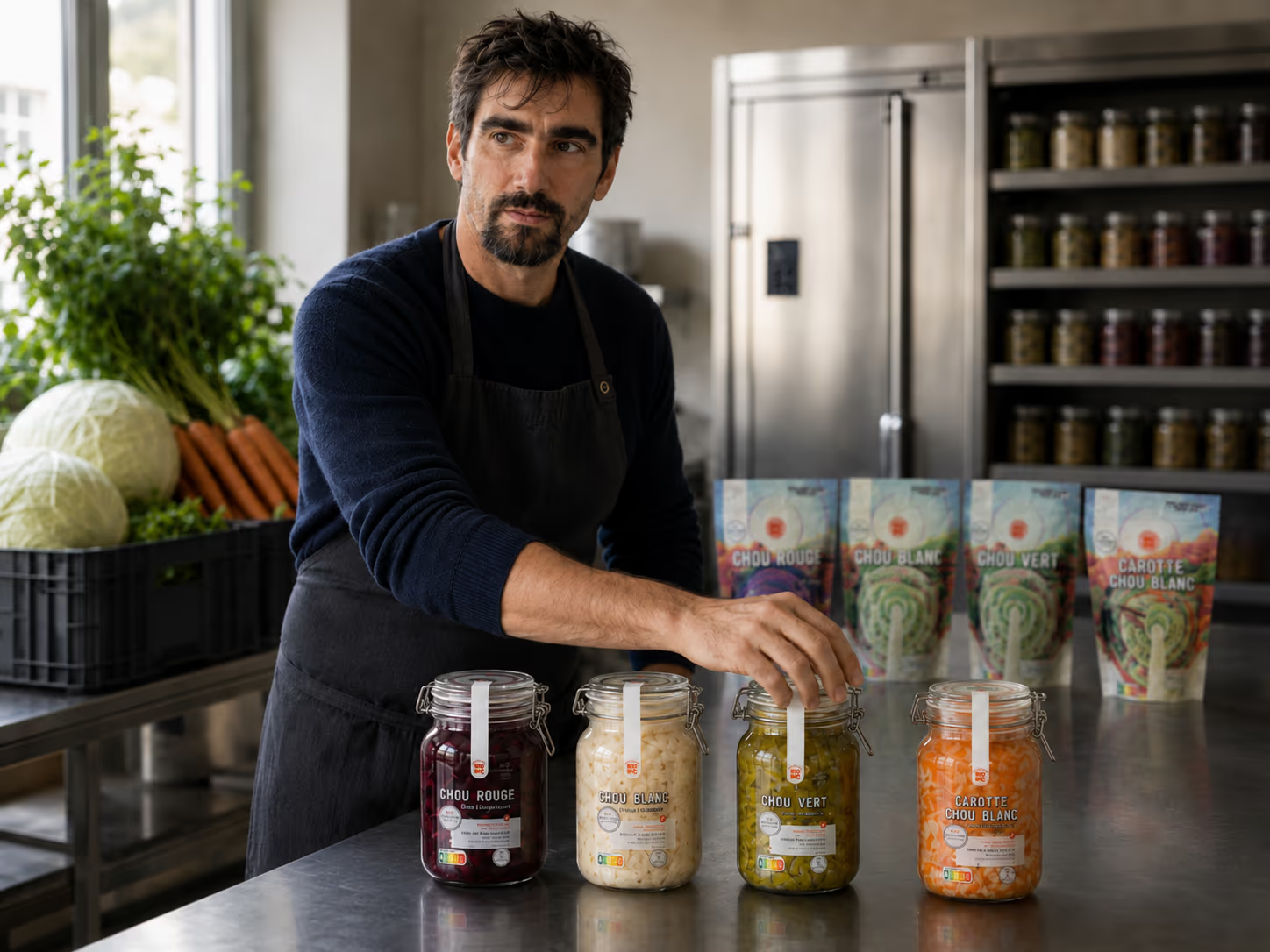
I didn't want to create one more product. I wanted to rebuild something I saw disappearing.
My family comes from the Grisons, from the mountains — and that's where my relationship with time and living matter comes from. In my family, fermentation was never an abstract idea: my great-grandmother was a winemaker in the mountains, my grandparents were bakers. Wine, bread, simple gestures, the kind of production that demands patience and attention — I grew up with that.
Over the years, I watched many products lose that truth — too standardised, too processed, too far from what they claim to be. With fermentation it was glaring: pasteurised products, often meant to be cooked again, become convenient but stripped of the essence of their character.
BIONIC was born from that refusal. Not from nostalgia, not from a lesson to teach, but from a concrete desire: to rebuild a serious, Swiss, simple and good alternative, able to put a living food back at the centre of meals.
That's why I started my company. BIONIC is a contraction: BIO, for the values that guide our work and our respect for living things, and NIC, for Nicolas, my first name. A simple name for a simple idea — doing things properly, with time, patience and taste.
We don't aim to make it complicated.
We aim to make it right.
Taking up a tradition, without freezing it
We chose lacto-fermented vegetables because they already belong to our table. In Switzerland, fermentation is nothing exotic: sauerkraut is well known, popular, deeply rooted. But it's been reduced to a cooked, heavy, occasional side — far from what a controlled fermentation can give: crunch, acidity, freshness, depth, a real presence on the plate.
Fermentation should be neither austere, nor marginal, nor reserved for insiders. It must become again what it has always been: a natural, intelligent and flavourful way to transform food. Our rule is simple: if the product isn't good, if it isn't appealing, the discourse is worthless.
The living demands precision
We work with unpasteurised lacto-fermented vegetables. This choice is central, and it doesn't forgive approximation. It means respecting the cold chain, following the maturation, controlling every batch, never cheating with the process.
I like to compare it to wine. A living product evolves; it holds thanks to time, method and respect for its nature. That's why producing in Switzerland is not, for us, a line on a label: it's a way of working. Swiss vegetables chosen for their variety and their texture, work by hand, attention to detail, a cold chain that links the workshop to the customer's fridge.
A living product isn't forced.
It's accompanied.
A reflex, not an occasion
A large part of our work is invisible: monitoring the fermentation, controlling the batches, balancing the acidity, the cold. The customer doesn't have to think about it. They open a jar or a pouch, add a few forkfuls to their plate, and immediately feel what the product brings: freshness, relief, crunch, controlled acidity.
BIONIC is made for those who want to compose their meals better without complicating them. In a bowl, in a salad, in a sandwich, next to a raclette, with a fondue, on a simple plate. Our vegetables are made to become a fridge reflex — not a product kept for an occasion.
A few forkfuls are enough
to transform a meal.
Putting the living back at the centre of the table
BIONIC started with simple products. That's deliberate. A simple product can be premium when the matter, the method and the taste are respected.
That's what we want to prove: that you can return to the basics without going backwards. That a tradition can modernise without emptying itself of meaning. That lactic fermentation can find a central place again in our food — not because it's fashionable, but because it's good, precise and deeply tied to our history.
No shortcuts. Just Swiss living food, crunch — and the taste of coming back to the table.